DJ.

The work

Not side projects. Products.

01
Live in productionPayments shippedSolo founded

GoBursar

Paste in a scholarship. It tells you what the committee actually rewards, with a source link behind every claim, plus essay coaching built on your own background.

The problem

Scholarship pages are vague. They say things like leadership and community involvement, and students can't tell what the committee is looking for or whether they have a real shot. So they skip good opportunities or burn hours on long shots.

What it does

Paste a scholarship in, and GoBursar researches the sponsor in real time: mission, judging criteria, past winner patterns when they can be found. It returns a cited brief with clickable sources, an honest fit verdict scored against your own profile, and essay coaching grounded in your real background. It even tells you when to skip one.

The edge

Every claim in a brief is backed by a real, resolved source link. Not a hallucinated citation, not a redirect that dies next week. Receipts, not vibes. That research layer is the hardest thing for a competitor to fake, and it's what makes the fit verdict worth acting on, even when it says skip this one.

My role

Solo founder. Product, design, development, privacy policy and terms, COPPA considerations for users under 18, pricing strategy, and all of the go to market work: SEO content, outreach, and social.

How it's built
Every citation is resolved and verified before the brief ships, so no claim lands on an invented source.
Grounded web search feeds a structured synthesis step, so the brief is research first and prose second.
Stripe checkout, webhooks, and entitlement checks built end to end, with one time passes instead of a subscription.
A forward to funder flow lets a parent pay through a shareable checkout link, since the parent is often the actual buyer.
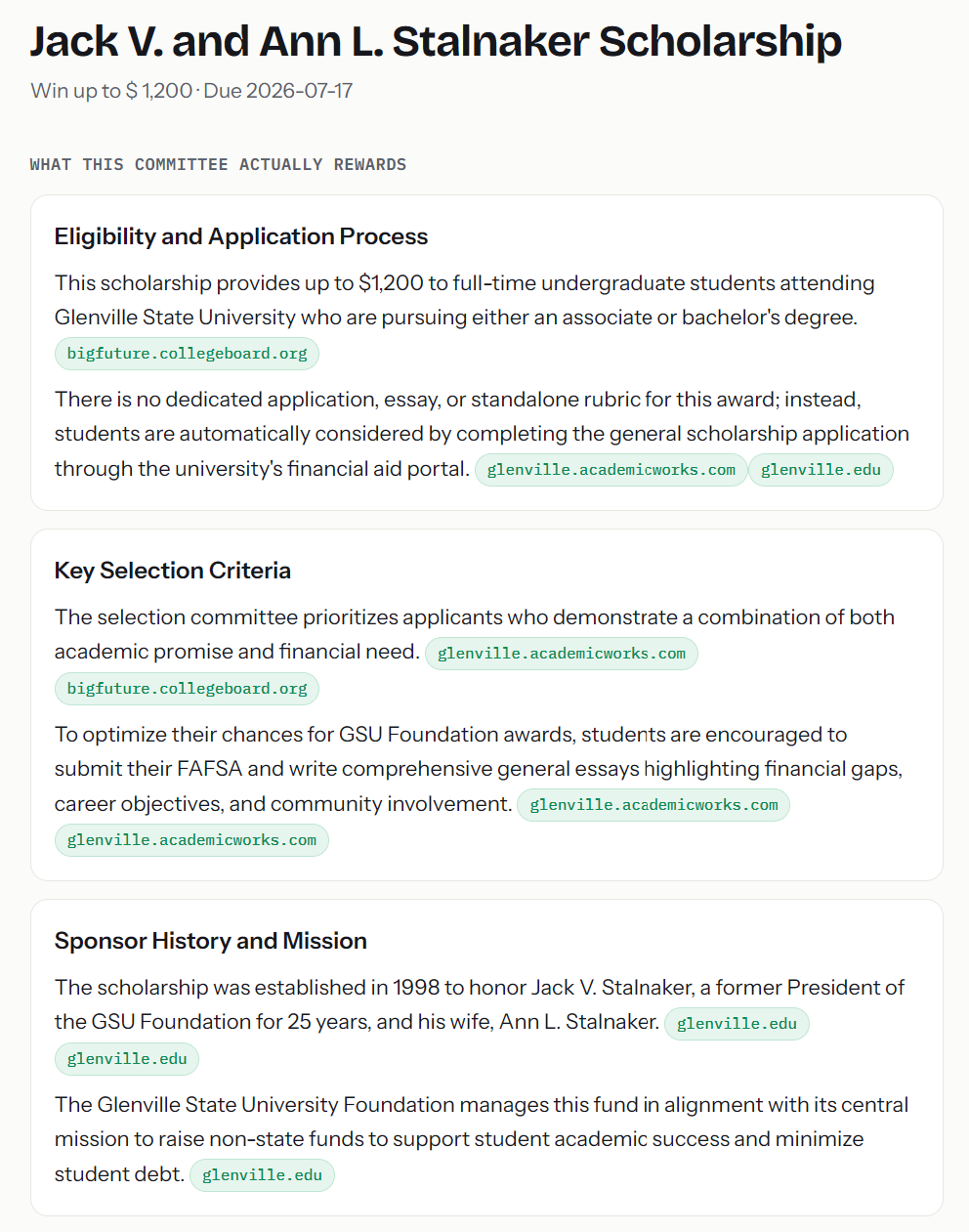
A real GoBursar brief for the Jack V. and Ann L. Stalnaker Scholarship, showing what the committee actually rewards with cited source links

A real brief. Every claim carries a clickable source, and that's the whole point.

Live

Status

Built end to end

Payments

1

Team size

Next.jsTailwind CSSNetlifySupabaseGoogle GeminiStripeResend
02
Live on iOSLive on AndroidFreemium + Pro

PantryPulse

Scan a receipt, or just take a photo of the shelf. PantryPulse knows what you have, tells you what is about to go bad, and turns it into dinner.

The problem

Everybody has a shelf of food they forgot about. Groceries expire, money gets thrown away, and 'what's for dinner' stays a daily negotiation.

What it does

PantryPulse tracks what's actually in your kitchen with barcode scanning, receipt scanning, and a vision scanner that turns a photo into inventory. An AI chef generates recipes from what you really have, and shared households keep the whole family or the whole apartment on the same page.

The edge

Most kitchen apps are a list you have to maintain by hand. This one watches the inventory for you, and the engineering underneath it is the part I am proudest of.

My role

Solo founder. Mobile engineering, backend and security, AI integration, and growth: freemium pricing, organic marketing on Reddit and TikTok with zero ad spend, SEO with schema markup and a content hub, ASO research, and analytics driven decisions.

How it's built

A custom AWS Lambda proxy sits between the app and the model, so the client never touches the AI provider directly.
A three layer model fallback chain keeps the app working when a provider degrades.
An in app assistant answers questions in plain language and can control parts of the app for you.
A vision scanner turns one photo into structured pantry items.
Two inventory modes, counted units and partial amounts, with FIFO deduction across expiry date, creation date, and ID.
Multi household data isolation with server authoritative subscription checks. I found and closed a real row level security hole myself.

Live

iOS

Live

Android

$0

Ad spend

FlutterRiverpodSupabaseGoogle GeminiAWS LambdaRevenueCatSpoonacularCodemagic

Both of these started as a blank folder.